Engineer Marvels at Robotic Surgery Treatment Solution for His Prostate Cancer
70-year-old Carl Bedingfield approached his prostate cancer diagnosis in a fashion befitting an engineer.
Bedingfield, who works for a large telecommunications company, spends a great deal of time-solving problems through innovation, with more than 150 patents to prove it. So, when he was facing prostate cancer treatment, Bedingfield dove deep into research. As someone who prefers to document his work in writing, he decided to blog about his experience as a form of therapy.
In late 2019, a blood test showed Bedingfield’s prostate-specific antigen was exceeding the normal range. His primary care physician referred him to Georgia Urology’s Dr. Brent Sharpe. After an exam and additional testing, Dr. Sharpe recommended a biopsy.
“The biopsy showed I had prostate cancer that can be classified as an intermediate risk,” he recalls. “Cancer at this level needs to be treated. The primary treatment options are radiation and surgical removal.”
That’s when Bedingfield began studying these options. This included consulting with both a radiation oncologist and Dr. Sharpe, researching efficacy and side effects of each, and talking with those who have dealt with the disease themselves.
“There are really two major considerations,” he says. “One is how effective is the choice of the treatment. The other is what are the side effects and how that pans out over time. After looking at all of that, I chose removal.”
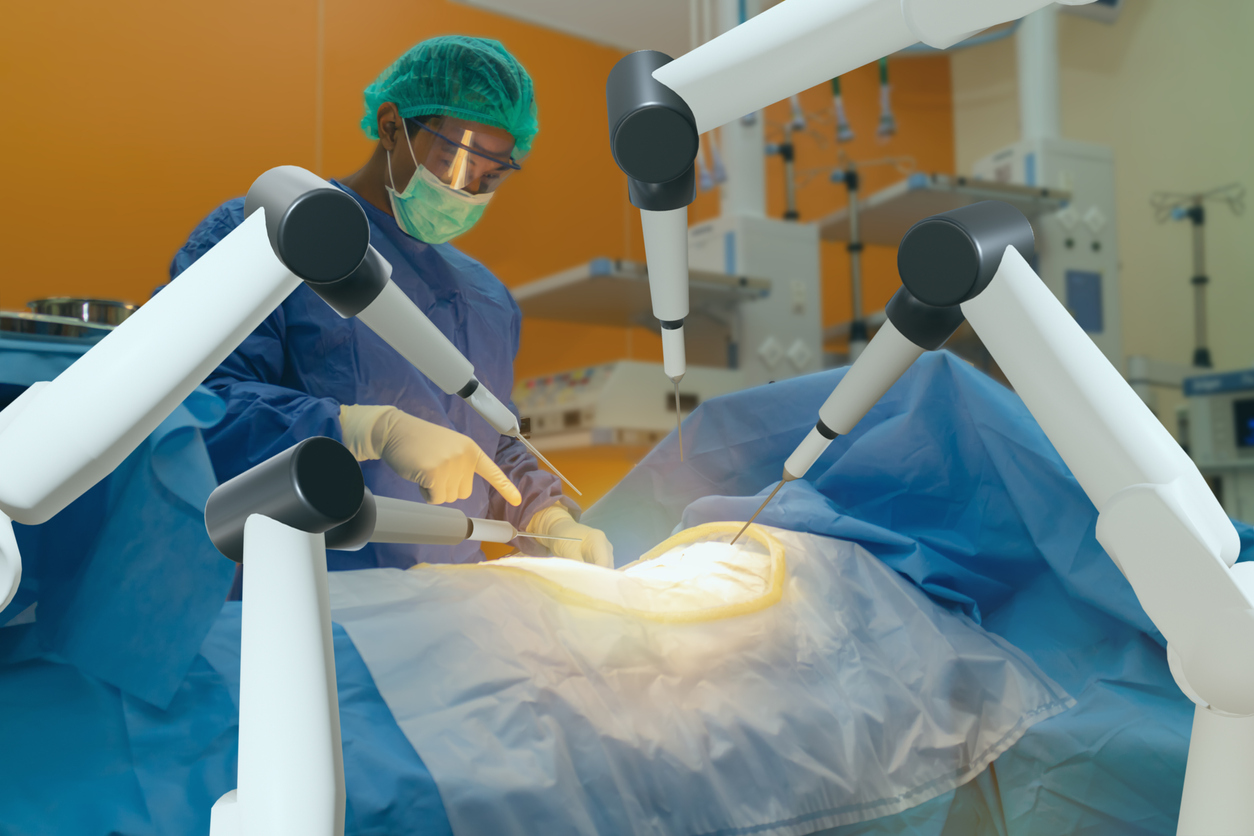
The scheduled prostatectomy with Dr. Sharpe at the helm took place in April 2020. Bedingfield’s fascination with innovation ironically found him being on the receiving end of such methods. One of the last things he says he remembers seeing before going under anesthesia is what he describes as “a six-foot-tall machine with multiple arms.”
That was the da Vinci robot, the state-of-the-art technology used to perform robotically-assisted laparoscopic surgery. After making a few small incisions, Dr. Sharpe operated the robot remotely, while viewing magnified images from the laparoscopic camera on a video screen. Using the special long-handled tools attached to the da Vinci’s arms, Dr. Sharpe was able to successfully remove Bedingfield’s prostate. After an overnight stay in the hospital, Bedingfield returned home to recuperate.
“I was very impressed with the technology and fascinated by the surgical process,” he says. “It was considerably more simple, less impactful as far as recovery and scarring than other surgeries. From the patient’s point-of-view, it was pretty low-key. It was amazing.”
Physical therapy followed, and Bedingfield eventually returned to his regular home exercise regimen of rowing and biking for cardio, and yoga for flexibility. Several months after the surgery, his PSA remains in the indetectable range, his bodily functions continue to improve, and side effects are now at a minimum.
As an engineer, Bedingfield keeps pushing the boundaries of innovation, while marveling at the technology used to remedy his ailment.
“Just to be sure, now that we know more today than we knew yesterday, I continue to focus on things I can control, rather than fretting about things I can’t,” Bedingfield wrote on his blog. “And I am still at peace.”
To make an appointment with a Georgia Urology physician, schedule online or call one of our office locations.