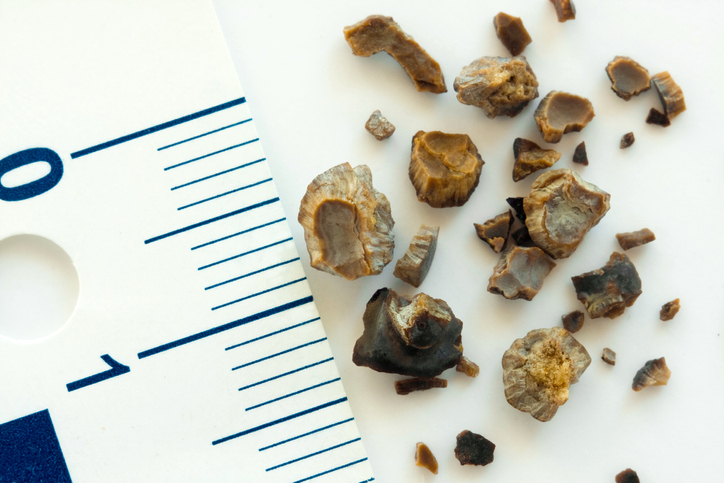
When it comes to kidney stones, we have the dubious distinction of living in the stone belt – the southeast United States, where summers get hot and humid, promoting dehydration and kidney stones. As a result, kidney stone management is one of the most often performed services here at Georgia Urology. There are several effective treatment options for kidney stones. Smaller stones (those 4mm and under) are usually managed with increased hydration, allowing the patient to pass them in time. However, larger stones may need a procedure of which there are several.
ESWL may be a good choice for patients with softer calcium-based stones that are easier to break up and visible on X-ray. Most patients try ESWL because it is non-invasive, using shockwaves generated outside the body and concentrated on the stone to break it up. The fact that nothing is inserted into the body and no surgery is necessary is very appealing. On the flip side, however, there is no guarantee that ESWL will break up the stone enough to allow every piece to pass. This is especially true for larger and harder stones. Remember that remnant stone material promotes more stone formation as new stone-developing matter attaches to the leftover fragments. ESWL is best suited to stones within the kidney.
The Case for Ureteroscopy With Laser Lithotripsy
Ureteroscopy is a simple procedure in which a semi-rigid or rigid scope is threaded through the urethra and bladder and into the ureter (the urine tube connecting the kidney to the bladder). This scope helps us identify and, ultimately, treat the kidney stone that is trapped in the ureter and causing symptoms. At this point, we can deploy a highly concentrated laser onto the kidney stone to break it up into tiny pieces. Many patients are concerned that this is a more invasive option versus ESWL and are also worried about the temporary stent that needs to be placed to keep the ureter open after treatment. However, these potential concerns should be weighed against the fact that patients are almost always stone-free after lithotripsy. This minimizes the risk of stones developing in the future, though lifestyle change, in the form of better hydration, is still important.
The Bottom Line
ESWL and ureteroscopy with laser lithotripsy are both excellent options for treating kidney stones. ESWL is often used for calcium-based stones within the kidneys, which are visible on X-rays. It is ideal for softer stones that can be broken up without direct visualization. On the other hand, ureteroscopy with laser lithotripsy is a good option for larger, harder stones that have lodged in the ureter. Our physicians’ direct visualization and ability to directly treat the stone with laser technology means that the stone-free rate is much higher – upwards of 90%. Most importantly, our goal is to eliminate kidney stones safely and effectively. Schedule a consultation with a Georgia Urology physician to learn about the best kidney stone treatment option for your particular circumstance.
Kidney stone treatment is one of the most straightforward parts of a urologist’s practice. We have a multitude of treatment options ranging from non-invasive to surgical that can help patients eliminate the pain and, in many cases, become entirely stone-free. Even complex kidney stone situations can be managed through a combination of procedures and lifestyle […]
By Dr. Barry M. Zisholtz, M.D., F. A. C. S Kidney stones have been documented for thousands of years. They have been discovered in ancient Egyptian mummies, clearly well before we had the type of instrumentation and technology that we have in the 21st century. It is almost impossible to comprehend how ancient man dealt with something […]
Although kidney stones are rarely life threatening, they might not feel like it. In fact, they can be extremely painful. Here is some basic information about this condition, along with possible treatment options. What Are Kidney Stones? Kidney stones are small deposits that form on the insides of the kidneys when urine becomes too concentrated, […]