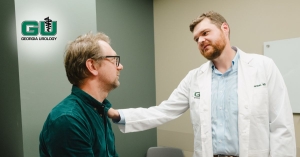
Dr. Barry Zisholtz took one look at his patient and recognized the problem: an ischemic priapism. Roderick, a retiree in his late 60s, was in intense pain due to a prolonged erection caused by constant arterial blood flow to the penis.
The patient explained he had sought help at a men’s clinic after several years of gradual progressing erectile dysfunction (ED). As part of the treatment and evaluation, the clinic staff gave Roderick a penile injection to help treat and diagnose his condition.
A prolonged erection followed. “The swelling was awful,” Roderick says, “and the pain was extremely severe.”
Roderick called the clinic, only to be told he was out of luck, because they don’t work weekends. A trip to the emergency room followed, and the physician referred him to Dr. Zisholtz of Georgia Urology. At this point, Roderick was barely able to walk.
“Prolonged erections are relatively rare,” Dr. Zisholtz explains. “However, it is more common in recent years, which may be due to an increasing number of ED treatments such as penile injections.”
Other medical treatments can also cause priapism, and it’s up to a trained urologist to remedy the situation. Some ‘clinics’ may not be able or willing to handle these complications, as it appeared in this particular case.
Upon diagnosing Roderick with an ischemic priapism, Dr. Zisholtz offered to perform a shunt procedure, which would divert the arterial blood from the penis back into the venous system. In an effort to avoid the procedure, Roderick opted to return to the men’s clinic for treatment, but they could not offer him a solution.
After a week of continuing to experience a painful erection, Roderick returned to Georgia Urology and was told he may never be functional again. This time he chose to move forward with an irrigation and possible shunting procedure.
He underwent a procedure under anesthesia, which included the injection of a medicine to decrease blood flow.
“We did extensive drainage and irrigation of his penis,” Dr. Zisholtz recalls, “and finally the erection subsided. He had amazing success with the procedure and was extremely thankful.”
Thanks to Dr. Zisholtz’s extensive knowledge of ischemic priapisms and his subsequent treatment plan, Roderick’s condition was caught in time. By the next day, Roderick noticed complete pain relief. It took some time to regain function. Today, however, he is in full recovery and no longer experiences erectile dysfunction or has to take any additional medications.
“I’m very grateful for Dr. Zisholtz’s guidance and fantastic work,” Roderick says. “I feel like I’m 21 years old again.”
On its own, diabetes can be a difficult condition to manage. Unfortunately, this illness often comes with associated problems, including erectile dysfunction. If you are dealing with diabetes and erectile function at the same time, the information below will help you to better understand the issue and find the right treatment. About Erectile Dysfunction and […]
Peyronie’s Disease, an abnormal penile curvature, is a disease that can cause significant physical as well as psychological distress. Peyronie’s Disease is a disease of abnormal scar tissue in the penis, leading to a palpable bump or lump as well as curvature. This can cause pain with intercourse, pain for their partners, or distress that […]
By: Michael Kemper, M.D. With incredible advances in medical devices and modern, minimally invasive surgical techniques, we have an elegant solution for otherwise untreatable erectile dysfunction in the form of an inflatable penile prosthesis or penile implant. These implants have been around for quite some time, but as they have been refined, they are more easily […]