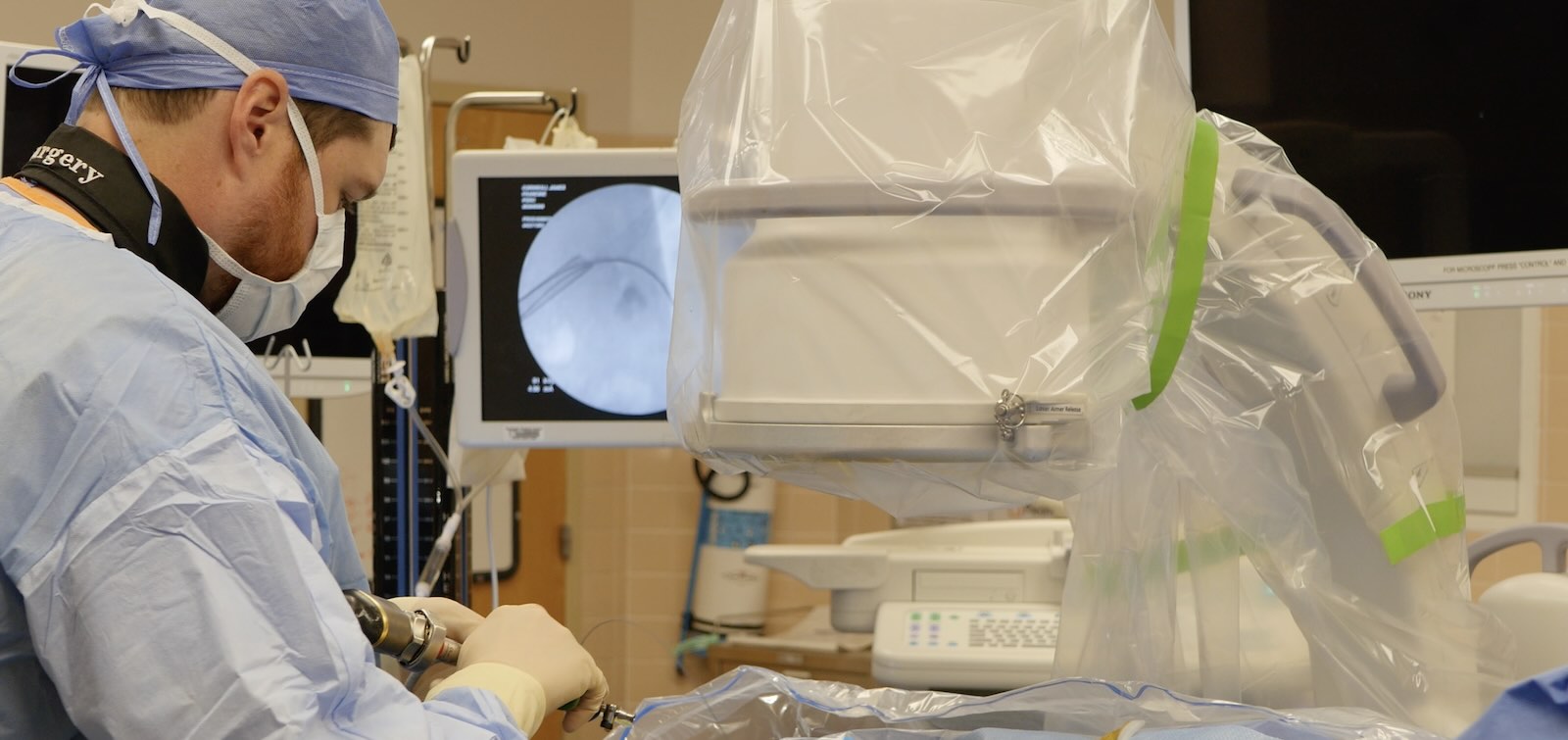
Robotic Prostatectomy
Minimally Invasive Treatment for Prostate Cancer

Minimally Invasive Treatment for Prostate Cancer
Surgery to treat prostatic cancer—and in particular the removal of the prostate, known as a prostatectomy—has made leaps and bounds since the old days of technologically unassisted open surgery.In the late 80s and early 90s, surgery took one of its most significant leaps forward with the advent of laparoscopy, using long-handled tools and tiny incisions to perform surgeries that would have otherwise required a single large incision.
Yet another advancement in surgical technique occurred when Intuitive Surgical brought the da Vinci robot to market. In fact, the gains were so significant that they related to prostate cancer that urology was one of the first specialties to achieve widespread adoption of this new technology.
Simply put, a prostatectomy is the removal of the prostate gland. This is almost always performed when a patient is diagnosed with intermediate-grade or high-grade prostate cancer, which we would consider to be relatively aggressive. Typically, depending on the specific details of the lesion, patients may have the option of a prostatectomy or radiation to treat the entire gland.
One of the biggest concerns of any surgical procedure on the prostate revolves around the nerves that control erectile function. Think of the nerves as a lattice of tissue as thin as Kleenex. You can imagine how difficult it is to spare these nerves and reduce the risk of ED, or erectile dysfunction.
But robotic surgery, with its precision, high-definition monitor, three-dimensional camera, and wristed tools, has the dexterity to allow surgeons to move away the intricate nerve tissues, allowing for a significantly reduced incidence of sexual dysfunction.
With that said, patients should understand that approximately 60% to 80% of those undergoing a radical prostatectomy, whether it is a nerve-sparing technique or not, will experience some form of erectile dysfunction, at least temporarily.¹ Many patients regain some or all of their function within a year; for those who do not, there are various treatment options.
No matter how small the prostate might be compared to other organs in the body, a radical prostatectomy is still a major surgery. As such, all associated hazards need to be considered against the benefits. The aforementioned advantages of robotic surgery have certainly reduced many risks, but there is no way to absolutely avoid pain or infection at the incision site, blood loss, erectile dysfunction, and incontinence. While the former are somewhat rare, the latter are instead quite expected.
Because of the risks and considerations mentioned above, your research may uncover that a radical prostatectomy is often not the preferred option for low-grade or certain intermediate-grade prostate cancers. For these patients, active surveillance or focal therapies like NanoKnife and High-Intensity Focused Ultrasound (HIFU) may be just what is needed to get the patient through this very concerning diagnosis.
Many patients with intermediate-grade or high-grade prostate cancer have a choice between two invasive therapies: a radical prostatectomy and radiation of the entire prostate gland. The option for both is, of course, based on your urologist’s diagnosis and your particular case. Both procedures typically cause erectile dysfunction and incontinence. This is usually immediate for the radical prostatectomy and delayed by a year or more in radiation.
Read our blog on the differences between whole-gland prostatic radiation and radical prostatectomy.
A robotic prostatectomy remains the gold standard in potentially curing intermediate-grade to high-grade prostate cancer in its early stages. Radical prostatectomy can be very beneficial for qualifying patients, but it is usually not the best option for patients with lower-grade cancers because of the side effects. For these patients, talking to a qualified urologist is the best way to take the next step in understanding how to treat prostate cancer.
Our Georgia Urology team of doctors is committed to providing the highest quality care for men with prostate cancer. We help each patient understand their risk factors, support early detection, and offer integrated care to improve outcomes and quality of life. Our goal is to provide an integrated system of care so that they can beat prostate cancer and continue living their fullest life.
Chrabieh, E., Beaineh, P., Sebai, T., Chekfa, A. J., Ghieh, F., Makkawi, K., Atiyeh, B., Bachir, B., & Ibrahim, A. (2025). Nerve Repair for Erectile Dysfunction After Radical Prostatectomy: A Systematic Review of Outcomes. Plastic and reconstructive surgery. Global open, 13(10), e7165. https://doi.org/10.1097/GOX.0000000000007165.