Prostate cancer is the most common solid malignancy in men. It can be seen in up to 40-50% of men as they approach 90 years of age. There are various stages and grades of prostate cancer, which is important to note, because each stage can determine whether and how a tumor should be treated.
Together with the patient, the physician helps create an individualized treatment plan based on diagnosis.
One type of treatment for prostate cancer involves destroying the cancer by freezing it with cryotherapy. This is done almost always as an outpatient procedure, and it is minimally invasive with minimal discomfort. Cryo-probes or freezing needles are inserted in the prostate and the perineum, allowing the gland to become an ice ball that can be seen on ultrasound at a temperature up to -40°C. At the same time during the process, the urethra is protected with a warmer, and we do continuous monitoring of the temperature around the rectum to protect the tissue.
We frequently use this procedure for people who have not experienced success with radiation therapy, since major salvage surgery afterward is quite risky and can be associated with more complications.
The most common side affects of cryoablation are erectile dysfunction and urinary leakage. For the most part, patients who require salvage cryoablation of the prostate after radiation already have a significant degree of erectile dysfunction. The risk of urinary leakage after previous radiation is higher than patients who have not had radiation before cryoablation, but is not very common.
Patients are usually discharged the same day with a catheter that remains in place 5-7 days as needed.
Let’s dive right in and get you the answer you want. There is no difference between Cialis and Tadalafil. They are the same compound, with Cialis being the brand name approved by the FDA in 2003, and Tadalafil being the generic name (representing a more accessible and cost-effective option than its branded counterpart) introduced when […]
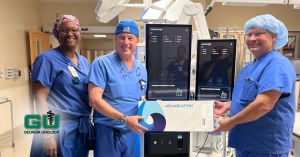
Northside Hospital Forsyth, in partnership with Georgia Urology, was the first in the world to offer Aquablation® therapy with the new HYDROS™ Robotic System. This next-generation platform is set to revolutionize the treatment for men suffering from benign prostatic hyperplasia (BPH), commonly known as an enlarged prostate. The new AI-powered robotic system offers a clinically […]
You brush your teeth. You try to eat your veggies. You may even stretch before workouts. But when was the last time you thought about your bladder? Your kidneys? The muscles and plumbing that help detoxify your body? Urologic health might not be the hottest wellness topic out there, but it’s a lot more critical […]