You Don’t Want to Live with Cancer, But Can You Live With the Treatment?
“We don’t want to cure the disease and break the man.”
A Southern accent on the UroNurse podcast begins by describing the importance of a life well-lived post-prostate cancer treatment, and you can hear the subdued excitement he’s holding back about his profession. Dr. Brent Sharpe loves what he does and cares about people becoming whole again: “My job is to work myself out of a job.”
That single sentence anchors the conversation. Prostate cancer care has long been dominated by survival-only thinking: remove the gland, radiate the tissue, eradicate the disease. These approaches have saved lives – but often at a cost that follows men for many years. Urinary incontinence, erectile dysfunction, repeated biopsies, and the loss of confidence, intimacy, and identity. The burden of living with treatment rather than simply living.
For more than a century, prostate cancer care lagged behind other cancers that evolved away from whole-organ removal toward targeted, tissue-sparing solutions. Treatment of prostate cancer, until recently, has maintained whole-gland punishment for a disease that may occupy only a fraction of the prostate.
That assumption is now being challenged. We no longer have to sacrifice the entire organ and accept collateral damage as inevitable.
The NanoKnife system introduces a broader paradigm shift in prostate cancer care that prioritizes precision preservation over indiscriminate destruction, and outcomes that matter to patients and not just pathology reports.
Board-certified in Urology, Dr. Sharpe focuses on men’s health. In this episode, “How NanoKnife Differs from Thermal Ablation Techniques,” he discusses the procedures involved in prostate cancer care, with quality of life at the forefront.
Deeper Into the Conversation
It helps to start with context. Prostate cancer is the most common male cancer worldwide. It affects roughly one in nine men, with more than 1.5 million new diagnoses each year – and those numbers don’t capture the many men navigating treatment or living post-treatment. Prostate cancer patients often survive for decades, which means living with the effects of treatment can become a long-standing challenge.
Surgery and radiation are designed to treat the entire prostate in a single setting. Despite being effective for cancer control, these approaches also bring predictable side effects. Even active surveillance, designed to avoid overtreatment, can be taxing: years of repeated biopsies, constant monitoring, and the stress of knowing cancer is present, and the effects of treatment may be just around the corner.
Against this backdrop, Dr. Sharpe introduces focal ablation, an approach that targets cancer more precisely.
Thermal techniques (methods using extreme heat or cold, like cryotherapy, laser ablation, and focal radiation) destroy tissues and inherently create scarring that can affect surrounding structures and limit future treatment options. Though designed to be precise and minimize scarring, potential complications of high-intensity focused ultrasound (HIFU), another treatment modality, include damage to the rectum (rectovesical fistula), bladder, or the urethral sphincter, which can lead to incontinence or erectile dysfunction. (The risk is still generally lower than with traditional surgery.)
Tissue-sparing focal ablation (distinct from focal radiation) is not new in oncology; breast, kidney, and other cancers have moved in this direction for decades. Prostate cancer has been slower to follow, and that lag, he argues, is no longer justified.
NanoKnife, also known as irreversible electroporation (IRE), uses highly controlled and targeted electrical energy to create microscopic pores in cancer cells, triggering cell death without burning or freezing tissue. Because the surrounding cellular architecture is preserved, critical structures, such as nerves, blood vessels, and the urethra, are protected. The result is targeted cancer treatment without the cascade of damage that has traditionally been accepted as unavoidable.
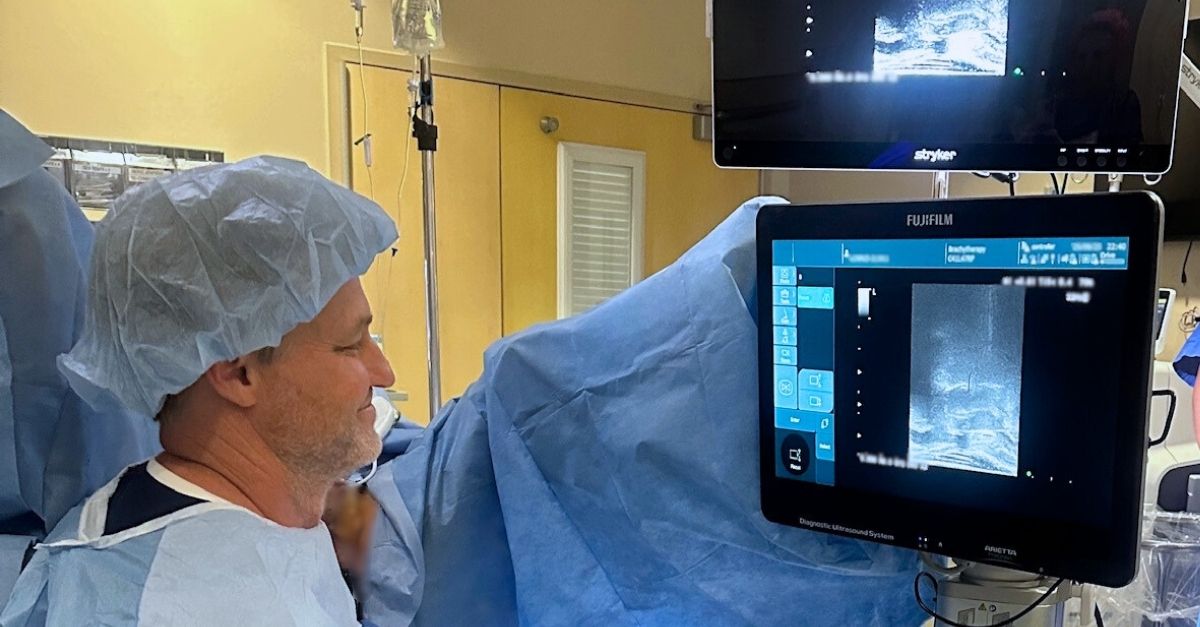
With a deliberate simplicity, Dr. Sharpe describes NanoKnife as an outpatient, incision-free treatment performed under ultrasound guidance. Thin probes are placed around the cancer, effectively “boxing it in” before any energy is delivered. This outside-in approach defines the treatment zone and establishes safety margins.
NanoKnife expands how to treat as well as who can be treated. Men with larger prostates, anterior tumors, calcifications, and bilateral disease presentations that are often considered limitations can be addressed by treating the prostate in regions. The NanoKnife system aims to remove disease, reduce complications, preserve future treatment choices, and minimize the physical and emotional toll that prostate cancer care can impose over a lifetime.
A Little Q&A
A few great questions from the audience and the hosts moved the conversation from theory to the practical realities that patients and clinicians face every day.
How long does a NanoKnife procedure take?
From start to finish, the procedure takes about an hour. That includes anesthesia, identifying treatment boundaries, establishing safety margins, probe placement, and real-time imaging. The actual delivery of electrical energy usually lasts under twenty minutes. But Dr. Sharpe takes the time every unique case deserves: “You cannot hurry surgery once you put the knife on the patient.” Precision matters more than speed.
Is NanoKnife an outpatient procedure, and do patients go home with a catheter?
Yes, NanoKnife is performed on an outpatient basis, and patients return home the same day. A temporary urinary catheter is required, usually for about a week. No patient welcomes a catheter, but it’s common across nearly all prostate procedures. Protocols are in place to minimize discomfort and avoid the need for reinsertion.
How are patients monitored after treatment?
Follow-up focuses on establishing a new baseline rather than eliminating PSA (prostate-specific antigen) entirely. PSA is monitored every three to six months during the first year, and most NanoKnife patients experience a 40-70% reduction. Imaging, including MRI and PSMA PET scans, combined with a follow-up biopsy around six months, will confirm treatment success. As outcomes continue to improve, one of Dr. Sharpe’s ongoing research goals is to reduce the need for repeated biopsies over time, easing the psychological and lifelong burden of surveillance or other therapeutic angles.
What about urinary symptoms and benign prostatic hyperplasia (BPH)?
One of Dr. Sharpe’s more unexpected observations has been improvement in lower urinary tract symptoms; they often stabilize or improve following NanoKnife treatment, and in some cases, men avoid separate BPH procedures altogether.
Some of the most gratifying moments come directly from patients. Dr. Sharpe recalls a 74-year-old patient who went from miserable urinary symptoms to declaring, “I pee like I’m 18.” It reflects how preserving tissue architecture can influence outcomes beyond cancer control alone.
Who is actually a candidate for NanoKnife?
This is where Dr. Sharpe unravels long-held assumptions. NanoKnife has been used successfully in men with low- and intermediate-risk prostate cancer, including unfavorable intermediate disease, as well as in select high-risk and salvage cases after radiation failure. Bilateral disease, once considered a disqualifier, can often be treated in stages by addressing the prostate in regions. As Dr. Sharpe repeatedly emphasizes, many limitations are not biological; they’re conceptual.
Why choose NanoKnife over thermal focal therapies in borderline cases?
The answer, according to Dr. Sharpe: because it does not burn bridges. Here’s the deal. Thermal therapies create scarring that can complicate future interventions. NanoKnife preserves tissue structure, allowing for retreatment or surgery later, if needed.
Newly entering an empty-nest phase of life, 54-year-old former hockey player told Dr. Sharpe he “just didn’t want this ripped from me.” Preserving intimacy was a top priority for him and his wife. In an era where many men live decades after diagnosis, maintaining future options is central to treatment decisions.
For Dr. Sharpe, the excitement of clinical practice is inseparable from the pursuit of innovation. Every NanoKnife procedure is an opportunity to restore function and quality of life, while advancing the science of prostate cancer care. “Precision preservation isn’t just a concept – it’s what we see in real patients every day,” he explains, reflecting on men walking out with confidence, intimacy, and futures intact.
At Georgia Urology, this cutting-edge research is happening in real time, and the work here demonstrates how innovation and outcomes coexist. Whether it’s a first diagnosis, a complex recurrence, or a patient seeking options, the physicians at Georgia Urology are pushing the boundaries.
For men facing prostate cancer today, the future isn’t just surviving – it’s living.
Dr. Brent Sharpe is a board-certified urologist with extensive experience in minimally invasive surgery, performing over 1,000 robotic procedures, 500 urological prostheses, and 200 Aquablation treatments. He treats all urological conditions but has special expertise in prostate enlargement (BPH), urological cancers, erectile dysfunction, vaginal prolapse, and prosthetic urology. Dr. Sharpe is the only surgeon in Georgia recognized as a Center of Excellence for both UroLift® and Rezūm™, and he has been designated as a NanoKnife Case Observation Site.